viernes, 23 de enero de 2015

Lab Session II - Intermolecular Forces Investigation: Evaporation Rate


1. An introduction to the physical property that your group was investigating and how it is related to IMF´s.

The evaporation rate of a material is the rate at which it will vaporize, this is, change from liquid to vapor, compared to the rate of vaporization of a specific standard known material. The general reference material for evaporation rates is n-butyl acetate (commonly abbreviated BuAc).
Moreover, it is important to know that evaporation rates normally have an inverse relationship to boiling points. The higher the boiling point, the lower the rate of evaporation.
This physical property is clearly related to IMF’s. If the chemical we are studying has weak intermolecular forces, it will need very little energy to break the bonds and therefore the molecules would separate easily from each and would vaporize quicker. This chemical would have a high evaporation rate as many molecules would reach the gas phase.
However, if the substance had strong IMF’s it would require much more energy in order for the molecules to separate, vaporize and reach the gas phase, as the bonds would be very tight. Therefore, very few molecules would evaporate and they would do it slower. The substance would have a low evaporation rate.
In conclusion, strong IMF’S slow evaporation rates and weak IMF’s accelerate evaporation rates. 

2. A description of the 2 groups of chemicals including; name, structure and types of IMF present.

Group 1 – Similar Molecular Weight: All the compounds in the following table have very similar molecular masses.


Group 2 – Homologous Series: The compounds in this table have a very similar structures and vary only by the number of CH2 units in the main carbon chain.


3. A prediction (hypothesis) of the results you expect with scientific explanations.

According to the theoretical background we expect certain results. We expect a substance with stronger IMF’s to have a lower evaporation rate, because it needs more energy in order to break its molecular bonds and so, less molecules would be able to reach the gas phase and they would do it slower. Some examples of these chemicals from Groups 1 and 2 are: Butanol, Propanoic acid, Propyl acetate and Butyl acetate, as they have Hydrogen Bonding, which is the strongest type of IMF.
As to substances with weaker IMF’s (Van der Waal’s and Dipole-Dipole forces), such as Diethyl Ether, Pentane, Methyl acetate and Ethyl acetate, they should have higher evaporation rates as they need less energy to break down bonds and more particles have more facility to reach the gas phase. 


4. Suitable tables of results (title, headings, units).


Butyl Acetate


Deithyl Ether


Propyl Acetate


Ethyl Acetate


Methyl Acetate


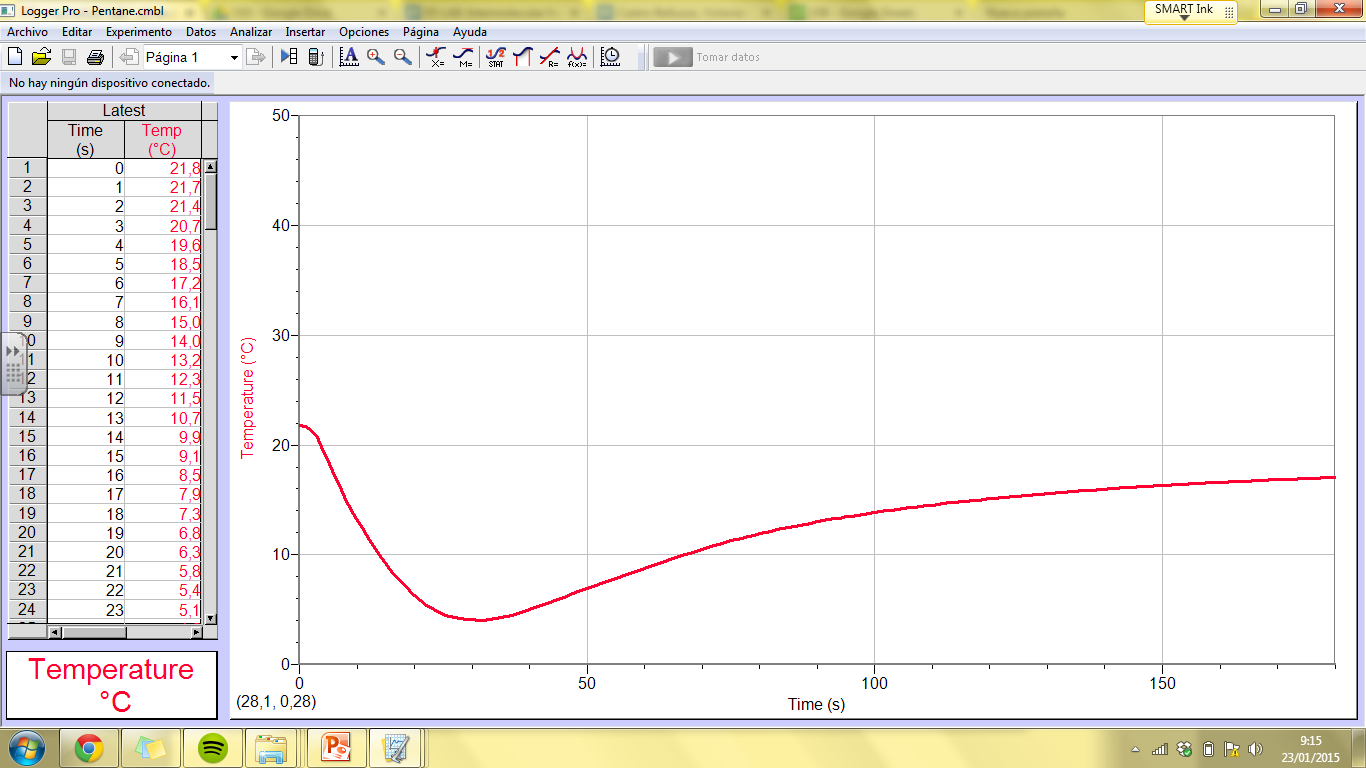
Pentane


Butanol 


Propanoic Acid


5. To what extent do your results match what you had expected

The results that we have come up with match exactly what we were expecting. Compounds with strong intermolecular forces evaporated very little or didn’t at all.  We would say the evaporation rate of these was minimal. However, the compounds with weaker intermolecular forces did evaporate and consequently have a higher evaporation rate. We can see this perfectly in the graphs. When the curvature is bigger, the higher the evaporation rate is.
We can say we are very satisfied with the data we recorded since it looks totally coherent.

6. An evaluation explaining areas where error could have occurred and how you would improve these areas in a future investigation.

So maybe the angle in which we put the stick inside the test tube wasn’t always the same and this could have altered the results since the machine  might not have gotten enough data. A possible solution to this would be to leave the stick in the test tube somewhere without moving it and this way the machine would always be in the same position and therefore the information would have been gathered always the same way. 

Another error in the method was that we didn’t measure the temperature of the test tube. If we don’t heat or cool the test tube to reach a certain temperature we don’t know if the temperatures in the different test tubes are the same. This is an essential fact when talking about evaporation rates as depending on temperature, which gives energy to the molecules inside chemicals, bonds in the substances will be more or less able to break down, which has a direct consequence on the vaporization of its particles. If temperature is lower, a chemical with strong bonds, such as hydrogen bonds, would have a very low evaporation rate. So, if we don’t have the same temperatures in each test tube, results won’t be reliable. A possible solution for this is simply measuring the temperature of each of the test tubes with a thermometer in order to have the same at each time. If needed we must heat or cool the test tube. 

Apart from this, we could have improved our accuracy while doing the experiment. But this is our mistake and we wouldn’t have to change the method for this.

7. At least 2 references in APA format.

Pubchem.ncbi.nlm.nih.gov,. (2015). PubChem. Retrieved 25 January 2015, from

BusinessDictionary.com,. (2015). What is evaporation rate? definition and meaning. Retrieved 25 January 2015, from http://www.businessdictionary.com/definition/evaporation-rate.html

Ilpi.com,. (2015). The MSDS HyperGlossary: Evaporation Rate. Retrieved 25 January 2015, from http://www.ilpi.com/msds/ref/evaporationrate.html

Socratic.org,. (2015). How do intermolecular forces affect evaporation? | Socratic. Retrieved 25 January 2015, from http://socratic.org/questions/how-do-intermolecular-forces-affect-evaporation


domingo, 30 de noviembre de 2014

How To Prepare a Schlenk Tube

Objective

Our objective is to demonstrate how to set up a Schlenk tube and explain what we use it for. 

Background

A Schlenk tube or Schlenk flask is a reaction vessel used mainly in air sensitive chemistry. This is, chemistry where we observe the reactivity of chemical compounds with some constituent of air (atmospheric oxygen, water vapor, carbon monoxide…).
It was invented by Wilhem Schlenk, a German chemist and it is made of borosilicate glass, which is resistant to thermal shocks. These occur when temperature causes different parts of an object to expand. When using a Schlenk tube, we might need grease to join stopcock valves and ground glass to prevent glass pieces from fusing. In this post we will explain how to set up a Schlenk tube and how to use a Vacuum line, which consists on a dual manifold with several ports.


Lab Session I - The properties of substances and their bonding

1.    A table of results.


Iron
Paraffin
Starch
Iron(II)Sulphate
Melting Point
HIGH
LOW
HIGH
HIGH
Solubility in Water
YES
NO
YES
NO
Solubility in Acetone
YES
NO
YES
NO
Conductivity
YES  *
NO
NO
YES

*Dissolved in a liquid

2.    The type of bonding present in each substance.

Iron: metallic bonding
Paraffin: covalent bonding
Starch: covalent bonding
Iron Sulphate: ionic bonding


3.  A secondary table to show “expected” results. 


Iron
Paraffin
Starch
Iron(II)Sulphate
Melting Point
HIGH
LOW
LOW
HIGH
Solubility in Water
NO
NO
NO
YES
Solubility in Acetone
NO
YES
NO
NO
Conductivity
YES  *
NO
NO
YES


4.  A conclusion comparing the actual results with the expected results.

As we can see when we compare our results table and the expected results table, the experiments with starch didn’t go as expected. Starch is considered a covalent compound, however the results weren’t as they should be considering the type of compound it is. This is because starch is an organic compound (more specifically a carbohydrate). It is a chain of monosaccharide, forming a polysaccharide which has a very fibrous structure and forms very strong bonds. This is the reason that it has a high melting point and is insoluble in water. Starch doesn’t dissolve in acetone because we’re assuming that acetone is a covalent compound and therefore non-polar. However, acetone is an exception and is polar.


In the experiments with iron and paraffin, the same happened with the solubility in acetone. The polarity we were assuming acetone had was non-polar and this is why the results varied. 

Another thing that shouldn't have happened according to the properties of the metallic bondings is the dissolution of iron in water and acetone. This could be due to the state of the iron. Maybe it was in a very light powder and this is the reason why it dissolved. 


5. An evaluation that suggests improvements that could be made to your method.

One of the problems with this method is timing. We didn’t know the exact time at which the solute melted or at what precise moment it totally mixed with the solvent (water and acetone). 

We could solve the problem of the melting points by using a Melting Point apparatus, such as OptiMelt, which gives you the exact temperature at which the substance melts. We could: use the machine to calculate the melting point of the four substances, heat each substance (controlling its temperature with a thermometer) during 3 min, and if in these three minutes the substance hasn't reached the melting point temperature, it means that it has a high melting point, while if it has already reached the exact temperature, it means that it has a low melting point. 

Also, we didn’t wait the same amount of time in each experiment, so probably the results are very weak and unreliable. This could be solved by using stopwatches and recording the same amount of time for all the experiments. As we have said before, 3 min should be enough.

The second problem is also related to the solubility of the substances. Even if we timed the time the solute took to dissolve, it would always be a rough measure as we were seeing it with a naked eye, that is, stopping the stopwatch when we thought the substance had dissolved. This could be solved by drawing something on a paper, and placing the test tube or the beaker over it. Thus, when we stop seeing the drawing, we know that the solute has dissolved.

However, when something dissolves in water the solution will most probably be transparent so we won't be able to see if it has completely dissolved. To make sure we have an accurate result we could draw a cross on a piece of paper and put it underneath the beaker and when the cross is utterly visible we will know that the substance is totally dissolved because the solution is transparent.  

Finally, we think that the results were not as expected because we didn’t use the same amount of substance in each experiment. This is, we couldn’t analyze the results equally, as these types of changes in what should be an independent variable are very significant. This could be improved by specifying how much quantity of solute we have to use.  To obtain a specific amount of solute of all the experiments we should measure it in a scale. This way will be sure that the amount is always the same.


6.  A minimum of 2 references (APA format)


Green, J., & Damji, S. (2001). Chemistry (1st ed.). Camberwell, Vic.: IBID Press.

Princeton.edu,. (2014). Paraffin. Retrieved 13 October 2014, from http://www.princeton.edu/~achaney/tmve/wiki100k/docs/Paraffin.html

Lenntech.com,. (2014). Iron (Fe) - Chemical properties, Health and Environmental effects. Retrieved 13 October 2014, from http://www.lenntech.com/periodic/elements/fe.htm


Cliffsnotes.com,. (2014). Organic Compounds. Retrieved 13 October 2014, from http://www.cliffsnotes.com/sciences/biology/biology/the-chemical-basis-of-life/organic-compounds